



Search titles
Displaying results 201 to 210 of 289.

Framing the Global Economic Downturn »
Crisis rhetoric and the politics of recessions
Edited by: Paul `t Hart, Karen Tindall
Publication date: September 2009
The global economic downturn that followed the collapse of major US financial institutions is no doubt the most significant crisis of our times. Its effects on corporate and governmental balance sheets have been devastating, as have been its impacts on the employment and well being of tens of millions of citizens. It continues to pose major challenges to national policymakers and institutions around the world.
Managing public uncertainty and anxiety is vital in coping with financial crises. This requires not just prompt action but, most of all, persuasive communication by government leaders. At the same time, the very occurrence of such crises raises acute questions about the effectiveness and robustness of current government policies and institutions. With the stakes being so high, defining and interpreting what is going on, how and why it happened, and what ought to be done now become key questions in the political and policy struggles that crises invariably unleash.
In this volume, we study how heads of government, finance ministers and national bank governors in eight countries as well as the EU engage in such ‘framing contests’, and how their attempts to interpret the cascading events of the economic downturn were publicly received. Using systematic content analysis of speeches and media coverage, this volume offers a unique comparative assessment of public leadership in times of crisis.

Agenda - A Journal of Policy Analysis and Reform: Volume 16, Number 3, 2009 »
Edited by: William Coleman
Publication date: September 2009
Agenda is a refereed, ECONLIT-indexed and RePEc-listed journal of the College of Business and Economics, The Australian National University. Launched in 1994, Agenda provides a forum for debate on public policy, mainly (but not exclusively) in Australia and New Zealand. It deals largely with economic issues but gives space to social and legal policy and also to the moral and philosophical foundations and implications of policy.
Subscribe to the Agenda Alerting service if you wish to be advised on forthcoming or new issues.
Download for free
Not available for purchase
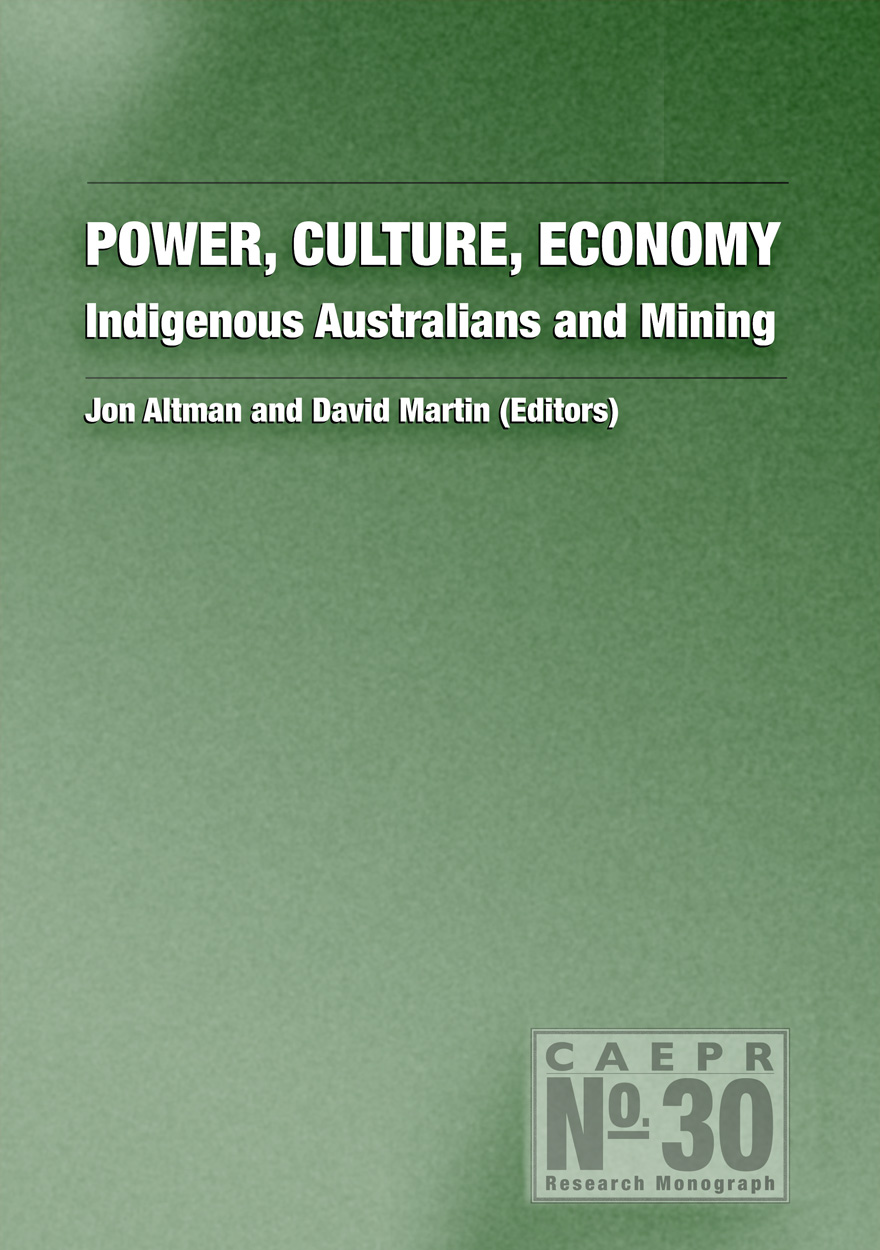
Power, Culture, Economy »
Indigenous Australians and Mining
Edited by: Jon Altman, David Martin
Publication date: August 2009
Research over the past decade in health, employment, life expectancy, child mortality, and household income has confirmed that Indigenous Australians are still Australia’s most disadvantaged group. Those residing in communities in regional and remote Australia are further disadvantaged because of the limited formal economic opportunities there. In these areas mining developments may be the major—and sometimes the only—contributors to regional economic development. However Indigenous communities have gained only relatively limited long-term economic development benefits from mining activity on land that they own or over which they have property rights of varying significance. Furthermore, while Indigenous people may place high value on realising particular non-economic benefits from mining agreements, there may be only limited capacity to deliver such benefits.
This collection of papers focuses on three large, ongoing mining operations in Queensland, Western Australia and the Northern Territory under two statutory regimes—the Aboriginal Land Rights (Northern Territory) Act 1976 and the Native Title Act 1993. The authors outline the institutional basis to greater industry involvement while describing and analysing the best practice principles that can be utilised both by companies and Indigenous community organisations. The research addresses questions such as:
What factors underlie successful investment in community relations and associated agreement governance and benefit packages for Indigenous communities?
How are economic and non-economic flows monitored?
What are the values and aspirations which Indigenous people may bring to bear in their engagement with mining developments?
What more should companies and government do to develop the capacity and sustainability of local Indigenous organisations?
What mining company strategies build community capacity to deal with impacts of mining? Are these adequate?
How to prepare for sustainable futures for Indigenous Australians after mine closure?
This research was conducted under an Australian Research Council Linkage Project, with Rio Tinto and the Committee for Economic Development of Australia as Industry Partners.

China's New Place in a World in Crisis »
Economic, Geopolitical and Environmental Dimensions
Edited by: Ross Garnaut, Ligang Song, Wing Thye Woo
Publication date: July 2009
The world and China’s place in it have been transformed over the past year. The pressures for change have come from the most severe global financial crisis ever. The crisis has accelerated China’s emergence as a great power. But China and its global partners have yet to think or work through the consequences of its new position for the governance of world affairs. China’s New Place in a World in Crisis discusses and provides in-depth analysis of the following questions. How have China’s growth prospects been affected by the global crisis? How will the crisis and China’s response to it impact China’s major domestic issues, such as industrialisation, urbanisation and the reform of the state-owned sector of the economy? How will the crisis and the international community’s response to it affect the rapidly emerging new international order? What will be China’s, and other major developing countries’, new role? Can China and the world find a way of breaking the nexus between economic growth and environmental sustainability — especially on the issue of climate change?

Agenda - A Journal of Policy Analysis and Reform: Volume 16, Number 2, 2009 »
Edited by: William Coleman
Publication date: June 2009
Agenda is a refereed, ECONLIT-indexed and RePEc-listed journal of the College of Business and Economics, The Australian National University. Launched in 1994, Agenda provides a forum for debate on public policy, mainly (but not exclusively) in Australia and New Zealand. It deals largely with economic issues but gives space to social and legal policy and also to the moral and philosophical foundations and implications of policy.
Subscribe to the Agenda Alerting service if you wish to be advised on forthcoming or new issues.
Download for free
Not available for purchase

Agenda - A Journal of Policy Analysis and Reform: Volume 16, Number 1, 2009 »
Edited by: William Coleman
Publication date: April 2009
Agenda is a refereed, ECONLIT-indexed and RePEc-listed journal of the College of Business and Economics, The Australian National University. Launched in 1994, Agenda provides a forum for debate on public policy, mainly (but not exclusively) in Australia and New Zealand. It deals largely with economic issues but gives space to social and legal policy and also to the moral and philosophical foundations and implications of policy.
Subscribe to the Agenda Alerting service if you wish to be advised on forthcoming or new issues.
Download for free
Not available for purchase

Agenda - A Journal of Policy Analysis and Reform: Volume 15, Number 4, 2008 »
Authored by: William Coleman, Alex Robson
Publication date: December 2008
Agenda is a refereed, ECONLIT-indexed and RePEc-listed journal of the College of Business and Economics, The Australian National University. Launched in 1994, Agenda provides a forum for debate on public policy, mainly (but not exclusively) in Australia and New Zealand. It deals largely with economic issues but gives space to social and legal policy and also to the moral and philosophical foundations and implications of policy.
Subscribe to the Agenda Alerting service if you wish to be advised on forthcoming or new issues.
Download for free
Not available for purchase

Agenda - A Journal of Policy Analysis and Reform: Volume 15, Number 3, 2008 »
Authored by: William Coleman, Alex Robson
Publication date: September 2008
Agenda is a refereed, ECONLIT-indexed and RePEc-listed journal of the College of Business and Economics, The Australian National University. Launched in 1994, Agenda provides a forum for debate on public policy, mainly (but not exclusively) in Australia and New Zealand. It deals largely with economic issues but gives space to social and legal policy and also to the moral and philosophical foundations and implications of policy.
Subscribe to the Agenda Alerting service if you wish to be advised on forthcoming or new issues.
Download for free
Not available for purchase

China's Dilemma »
Economic Growth, the Environment and Climate Change
Edited by: Ligang Song, Wing Thye Woo
Publication date: July 2008
China’s Dilemma—Economic Growth, the Environment and Climate Change examines the challenges China will have to confront in order to maintain rapid growth while coping with the global financial turbulence, some rising socially destabilising tensions such as income inequality, an over-exploited environment and the long-term pressures of global warming.
China’s Dilemma discusses key questions that will have an impact on China’s growth path and offers some in-depth analyses as to how China could confront these challenges. The authors address the effect of the global credit crunch and financial shocks on China’s economic growth; China’s contribution to greenhouse gas emissions and emissions reduction schemes; the environmental consequences of foreign direct investment in China; the relationship between air pollution and mortality; the effect of climate change on agricultural output; the coal industry’s compliance with tougher regulations; and the constraints water shortages may impose on China’s economy. It also emphasises the importance of managing the rising demand for energy to moderate oil price increases and placating domestic and international concerns about global warming.
In the thirty years since China started on the path of reform, it has emerged as one of the largest and most dynamic economies in the world. This carries with it the responsibility to balance the requirements of key industries that are driving its development with the need to ensure that its growth is both equitable and sustainable. China’s Dilemma highlights key lessons learned from the past thirty years of reform in order to pave the way for balanced and sustained growth in the future.

Agriculture and Food Security in China »
What Effect WTO Accession and Regional Trade Arrangements?
Edited by: Chunlai Chen, Ron Duncan
Publication date: June 2008
China’s accession to the World Trade Organization (WTO) has had profound consequences for the structure of its economy, and there will many more before the full benefits of an open trading regime will be realised.
Agriculture and Food Security in China explains the background to China’s WTO accession and links accession to reforms beginning as far back as 1979. The book highlights China’s policymakers’ decision to move away from protectionism and gain self-sufficiency, and illustrates how China’s step away from direct participation in the agricultural sector to indirect regulatory involvement and liberalisation could encourage further economic growth.
Yet not all economic growth is cost-free. Agriculture and Food Security in China explores the short-term impacts of WTO accession as well as the mid and long-term implications of greater market involvement at an economy-wide and regional level. Growing divides between coastal and inland regions—and differences in rural and urban growth—will require a better understanding of the consequences of greater market dependency.
Agriculture and Food Security in China adds to the existing knowledge of China’s agricultural growth as well as the impacts and interrelationships between WTO accession and China’s participation in other regional free trade agreements.