



Search titles
Displaying results 51 to 60 of 153.
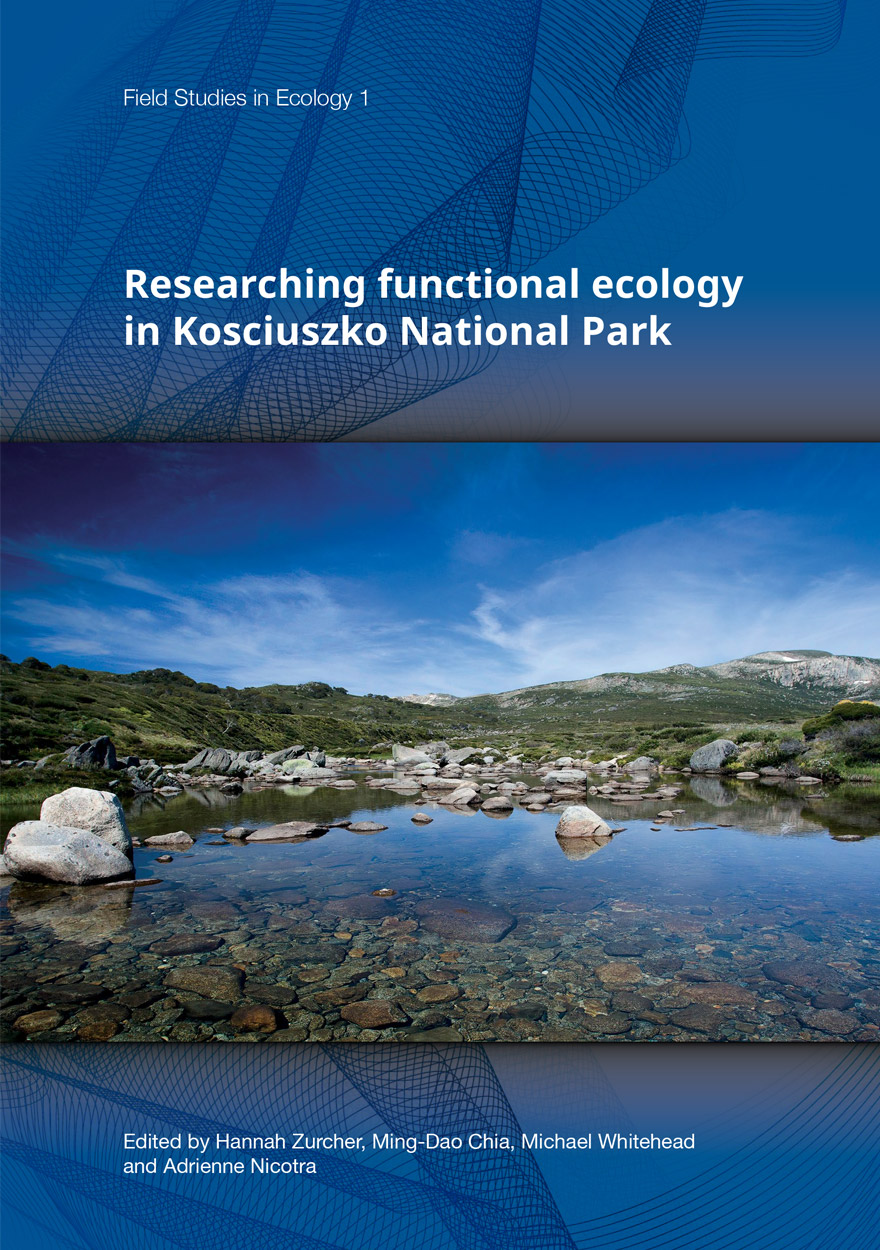
Researching functional ecology in Kosciuszko National Park »
Edited by: Hannah Zurcher, Ming-Dao Chia, Michael Whitehead, Adrienne Nicotra
Publication date: November 2017
Take 30 undergraduates and 20 experts from the Research School of Biology at The Australian National University, and put them together for 10 days in the high-altitude environment of Kosciuszko National Park in the Australian Alps. Challenge them to first identify research questions of potential importance to the survival of one of Australia’s unique ecosystems under threat from climate change, and then to answer those questions in scientifically rigorous and competent ways.
The successful outcomes of this challenge are evidenced in this volume of selected and fully peer-reviewed papers. They are all written by students who—after intense pre-field preparation—isolated intriguing research questions, postulated hypotheses, collected and analysed data, and interpreted their findings in the context of functional ecology theoretical frameworks and empirical evidence in the scientific literature. The experts acted as guides and supporters rather than lead researchers, so that the students—most of whom were at the end of their first year of studies—were all tasked with fully realising the concept of self-actuated research.
This book has much to offer ecologists, plant and animal scientists, protected area managers and anyone else interested in knowing more about the species of Kosciuszko National Park and how they live, survive, behave and interact. This book is also a showcase of just how much can be accomplished by bright and enthusiastic students who are trusted and guided to use their scientific and ecological knowledge and skills immediately. Much of the knowledge made available in these papers would simply not have seen the light of day except for this innovative intensive approach to research-based education. It is reassuring to know that the future of ecological research is in such capable hearts and minds!

Exploring the Earth under the Sea »
Australian and New Zealand achievements in the first phase of IODP Scientific Ocean Drilling, 2008–2013
Edited by: Neville Exon
Publication date: October 2017
Exploring the Earth under the Sea brings to life the world’s largest and longest-lived geological research program, which has been drilling over many decades at many locations deep below the ocean floor to recover continuous cores of sediment and rock. Study of these materials has helped us understand how the Earth works now, how it has worked in the past and how it may work in the future. The cores are a wonderful source of information on the dynamic processes that form and reform the Earth, both beneath the ocean and on land. The results have revealed climate and oceanographic change on different time frames, the history of life in the sea and on land including global mass extinctions, the extraordinary story of the great masses of ‘extremophile’ microbes that live beneath the sea bed, the nature of the giant earthquakes and tsunami generated at the trenches where tectonic plates collide, and the nature of submarine volcanoes and metalliferous deposits.
This book outlines the technology and enduring international partnerships that underlie the scientific ocean drilling accomplished by the first phase of IODP, currently involving 23 countries. It highlights the important role of Australian and New Zealand scientists in the program, and the great scientific benefits we have derived from our partnership since joining IODP in 2008. As well as the scientific summaries, there are personal accounts by shipboard scientists of how they found life at sea on two-month expeditions, working 12-hour shifts on a noisy drill ship.

International Review of Environmental History: Volume 3, Issue 2, 2017 »
Edited by: James Beattie
Publication date: October 2017
International Review of Environmental History takes an interdisciplinary and global approach to environmental history. It encourages scholars to think big and to tackle the challenges of writing environmental histories across different methodologies, nations, and time-scales. The journal embraces interdisciplinary, comparative and transnational methods, while still recognising the importance of locality in understanding these global processes.
The journal’s goal is to be read across disciplines, not just within history. It publishes on all thematic and geographic topics of environmental history, but especially encourage articles with perspectives focused on or developed from the southern hemisphere and the ‘global south’.
Download for free
Not available for purchase

Large-scale Mines and Local-level Politics »
Between New Caledonia and Papua New Guinea
Edited by: Colin Filer, Pierre-Yves Le Meur
Publication date: October 2017
Despite the difference in their populations and political status, New Caledonia and Papua New Guinea have comparable levels of economic dependence on the extraction and export of mineral resources. For this reason, the costs and benefits of large-scale mining projects for indigenous communities has been a major political issue in both jurisdictions, and one that has come to be negotiated through multiple channels at different levels of political organisation. The ‘resource boom’ that took place in the early years of the current century has only served to intensify the political contests and conflicts that surround the distribution of social, economic and environmental costs and benefits between community members and other ‘stakeholders’ in the large-scale mining industry. However, the mutual isolation of Anglophone and Francophone scholars has formed a barrier to systematic comparison of the relationship between large-scale mines and local-level politics in Papua New Guinea and New Caledonia, despite their geographical proximity. This collection of essays represents an effort to overcome this barrier, but is also intended as a major contribution to the growth of academic and political debate about the social impact of the large-scale mining industry in Melanesia and beyond.

Learning from Fukushima »
Nuclear power in East Asia
Edited by: Peter Van Ness, Mel Gurtov
Publication date: September 2017
Learning from Fukushima began as a project to respond in a helpful way to the March 2011 triple disaster (earthquake, tsunami, and nuclear meltdown) in north-eastern Japan. It evolved into a collaborative and comprehensive investigation of whether nuclear power was a realistic energy option for East Asia, especially for the 10 member-countries of ASEAN, none of which currently has an operational nuclear power plant. We address all the questions that a country must ask in considering the possibility of nuclear power, including cost of construction, staffing, regulation and liability, decommissioning, disposal of nuclear waste, and the impact on climate change. The authors are physicists, engineers, biologists, a public health physician, and international relations specialists. Each author presents the results of their work.
The Japanese translation of this book is available for purchase on the Ronso website.
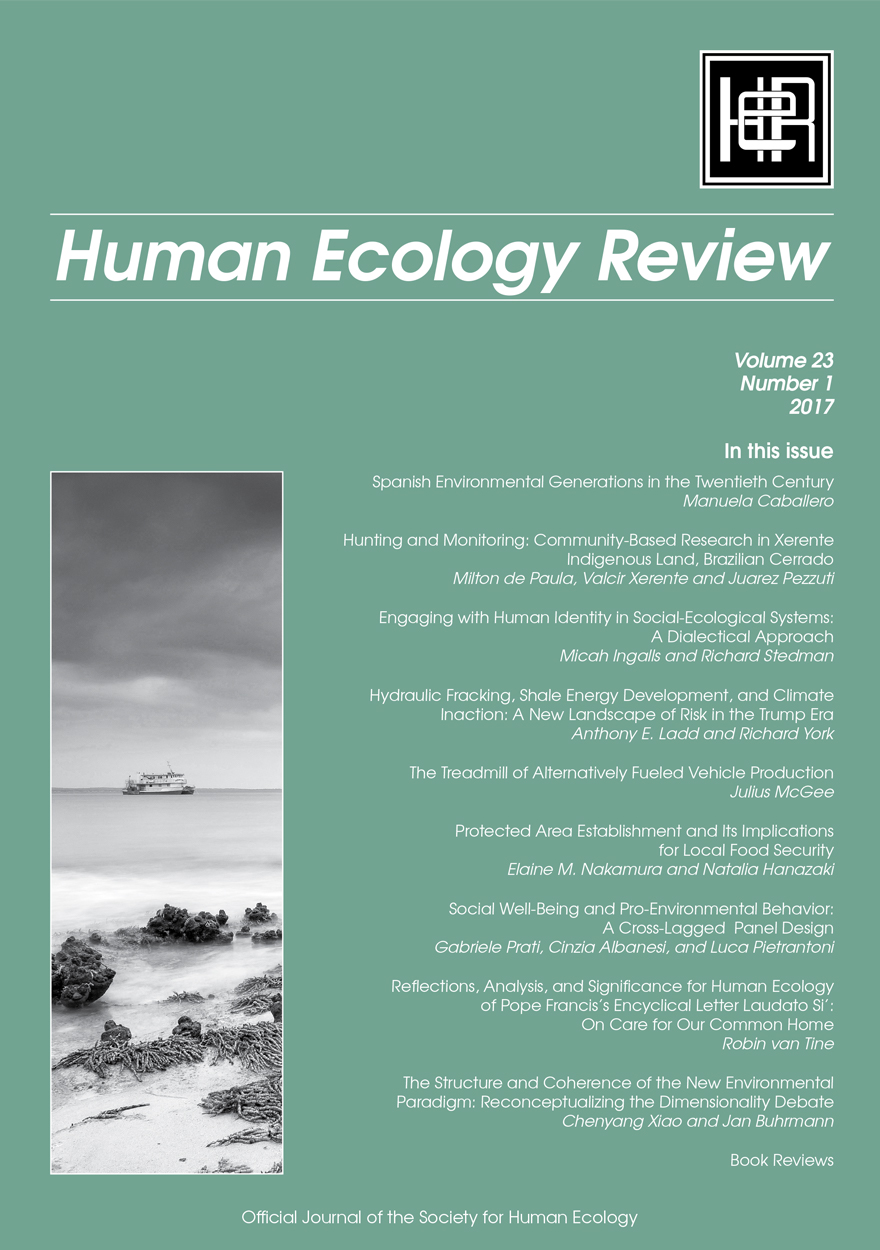
Human Ecology Review: Volume 23, Number 1 »
Publication date: September 2017
Human Ecology Review is a semi-annual journal that publishes peer-reviewed interdisciplinary research on all aspects of human–environment interactions (Research in Human Ecology). The journal also publishes essays, discussion papers, dialogue, and commentary on special topics relevant to human ecology (Human Ecology Forum), book reviews (Contemporary Human Ecology), and letters, announcements, and other items of interest (Human Ecology Bulletin). Human Ecology Review also publishes an occasional paper series in the Philosophy of Human Ecology and Social–Environmental Sustainability.
Download for free
Not available for purchase

The Human Voyage: Undergraduate Research in Biological Anthropology: Volume 1, 2017 »
Publication date: August 2017
The Human Voyage: Undergraduate Research in Biological Anthropology is a journal that publishes outstanding student articles in all areas of biological anthropology, including primatology, palaeoanthropology, bioarchaeology and human behavioural ecology.
While the primary goal of this journal is to publish work of the highest quality authored by undergraduate students, it will also educate students in regards to publishing in academia. All submissions will be peer-reviewed and edited by ANU academic staff.
Download for free
Not available for purchase

Ten Thousand Years of Cultivation at Kuk Swamp in the Highlands of Papua New Guinea »
Publication date: July 2017
Kuk is a settlement at c. 1600 m altitude in the upper Wahgi Valley of the Western Highlands Province of Papua New Guinea, near Mount Hagen, the provincial capital. The site forms part of the highland spine that runs for more than 2500 km from the western head of the island of New Guinea to the end of its eastern tail. Until the early 1930s, when the region was first explored by European outsiders, it was thought to be a single, uninhabited mountain chain. Instead, it was found to be a complex area of valleys and basins inhabited by large populations of people and pigs, supported by the intensive cultivation of the tropical American sweet potato on the slopes above swampy valley bottoms.
With the end of World War II, the area, with others, became a focus for the development of coffee and tea plantations, of which the establishment of Kuk Research Station was a result. Large-scale drainage of the swamps produced abundant evidence in the form of stone axes and preserved wooden digging sticks and spades for their past use in cultivation. Investigations in 1966 at a tea plantation in the upper Wahgi Valley by a small team from The Australian National University yielded a date of over 2000 years ago for a wooden stick collected from the bottom of a prehistoric ditch.
The establishment of Kuk Research Station a few kilometres away shortly afterwards provided an ideal opportunity for a research project.

Made in China Journal: Volume 2, Issue 2, 2017 »
Publication date: June 2017
In June 2017, the government of the United States announced its intention to withdraw from the Paris Accords, severely undermining the global effort to contain climate change. Since then, China has entered the fray, attempting to portray itself as a world leader on environmental issues. While global attention has focussed on China’s top-down environmental efforts, this issue considers the engagement of Chinese citizens with state policies on the environment, and looks into their potential for articulating workable grassroots alternatives. In particular, we consider the management of public resources—the so-called ‘commons’.
Download for free
Not available for purchase

International Review of Environmental History: Volume 3, Issue 1, 2017 »
Edited by: James Beattie
Publication date: June 2017
International Review of Environmental History takes an interdisciplinary and global approach to environmental history. It encourages scholars to think big and to tackle the challenges of writing environmental histories across different methodologies, nations, and time-scales. The journal embraces interdisciplinary, comparative and transnational methods, while still recognising the importance of locality in understanding these global processes.
The journal’s goal is to be read across disciplines, not just within history. It publishes on all thematic and geographic topics of environmental history, but especially encourage articles with perspectives focused on or developed from the southern hemisphere and the ‘global south’.
Download for free
Not available for purchase