



Miranda Forsyth
Professor, School of Regulation and Global Governance, ANU; Co‑Director, ANU Centre for Restorative Justice.
 https://orcid.org/0000-0001-8310-9551
Growing Restorative Regulation »
Publication date: 2026
Regulation that prioritises punishment over learning often fails to repair harm or build lasting compliance. It can alienate communities, deepen mistrust and do little to prevent future breaches.
Growing Restorative Regulation reveals an alternative approach – one grounded in dialogue, learning from multiple perspectives and ensuring active accountability. Drawing upon a multi-year institutional ethnography of an environmental regulator, the book shows how the principles of restorative justice can be used to address and prevent pollution and environmental harm. In so doing, it also illustrates how restorative approaches are applicable to a wide variety of other regulatory challenges. Throughout, the authors offer a practical framework for inclusive processes and relationship-building, involving local and Indigenous communities, and for transforming regulation into a system that actively repairs.
Essential reading for regulators, policymakers, business leaders, environmental advocates, community groups and regulatory scholars, Growing Restorative Regulation is a critical and constructive guide to seeding sustainable restorative practices into the very heart of regulatory decision-making.
Coming soon
Notify me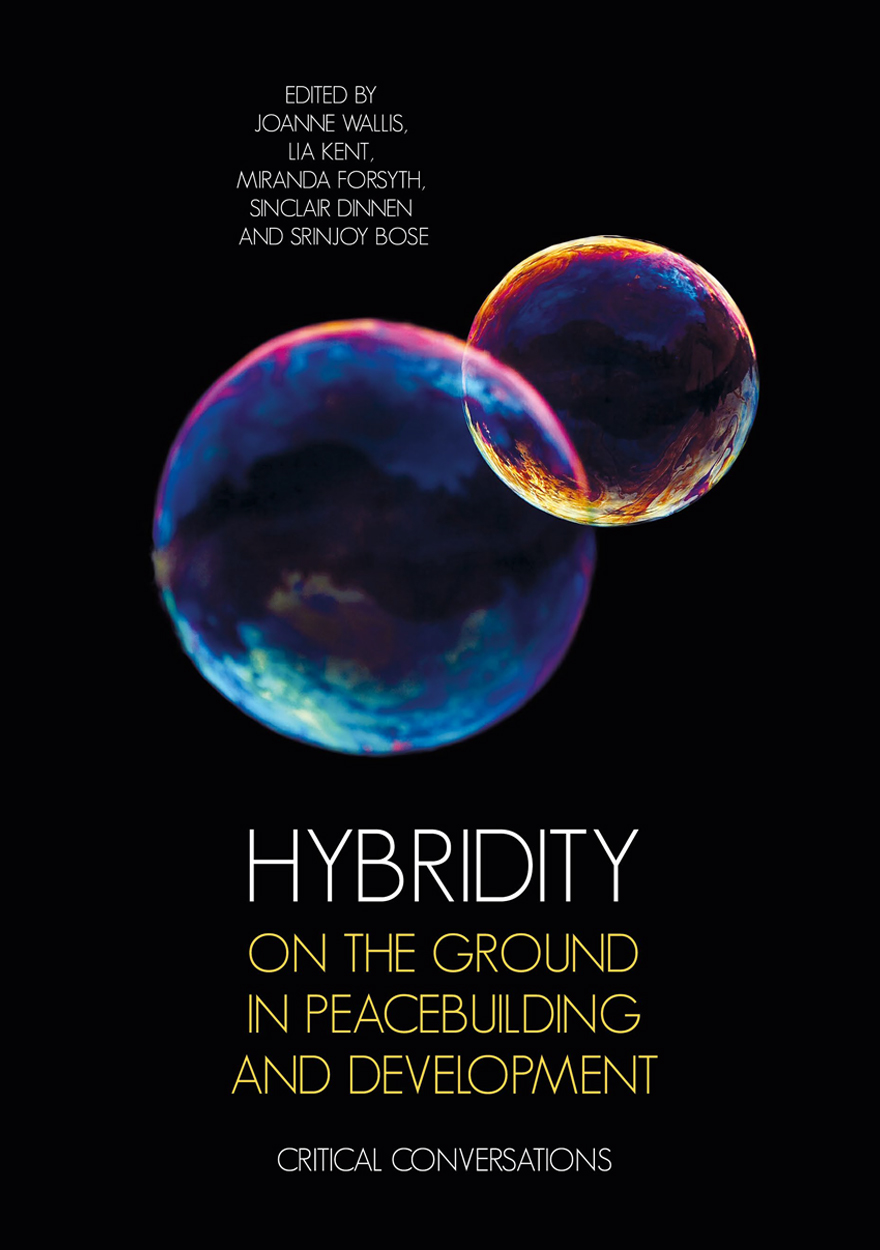
Hybridity on the Ground in Peacebuilding and Development »
Critical Conversations
Publication date: March 2018
Hybridity on the Ground in Peacebuilding and Development engages with the possibilities and pitfalls of the increasingly popular notion of hybridity. The hybridity concept has been embraced by scholars and practitioners in response to the social and institutional complexities of peacebuilding and development practice. In particular, the concept appears well-suited to making sense of the mutually constitutive outcomes of processes of interaction between diverse norms, institutions, actors and discourses in the context of contemporary peacebuilding and development engagements. At the same time, it has been criticised from a variety of perspectives for overlooking critical questions of history, power and scale. The authors in this interdisciplinary collection draw on their in‑depth knowledge of peacebuilding and development contexts in different parts of Asia, the Pacific and Africa to examine the messy and dynamic realities of hybridity ‘on the ground’. By critically exploring the power dynamics, and the diverse actors, ideas, practices and sites that shape hybrid peacebuilding and development across time and space, this book offers fresh insights to hybridity debates that will be of interest to both scholars and practitioners.
‘Hybridity has become an influential idea in peacebuilding and this volume will undoubtedly become the most influential collection on the idea. Nuance and sophistication characterises this engagement with hybridity.’
— Professor John Braithwaite
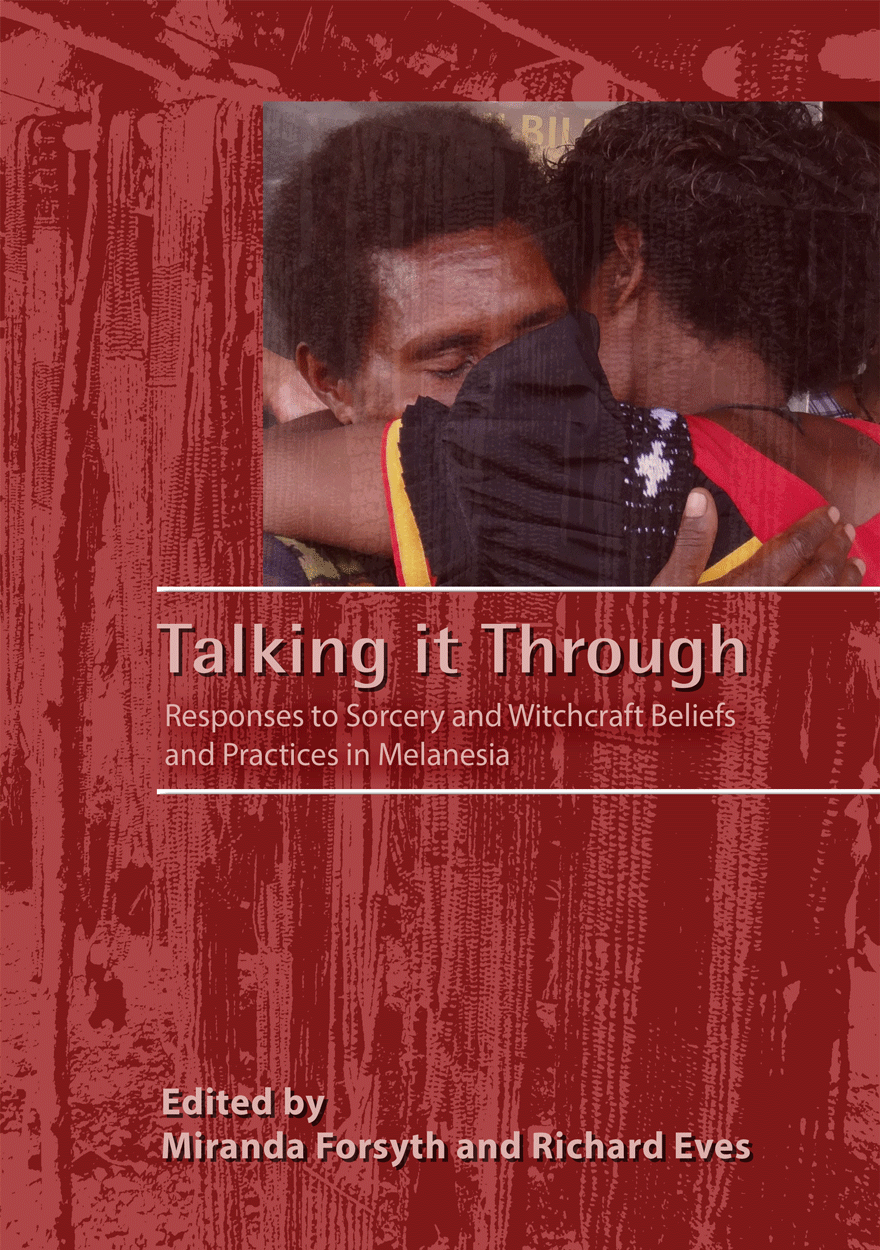
Talking it Through »
Responses to Sorcery and Witchcraft Beliefs and Practices in Melanesia
Edited by: Miranda Forsyth, Richard Eves
Publication date: May 2015
Sorcery and witchcraft practices and beliefs are pervasive across Melanesia. They are in part created by, and give rise to, a wide variety of poor social and developmental outcomes. These include uneven economic development, low public health, lack of social cohesion, crime, fear and insecurity. A further very visible problem is the attacks on men and women who are accused of being practitioners of witchcraft or sorcery, which can lead to serious bodily harm, banishment and sometimes death. Today, many communities, individuals, church organisations and policymakers in Melanesia and internationally are exploring ways to overcome the negative social outcomes associated with witchcraft and sorcery practices and beliefs. This book brings together a collection of chapters written by a diverse range of authors, both Melanesian and non-Melanesian, providing crucial insights both into how these practices and beliefs are playing out in contemporary Melanesia, and also the types of interventions that are being trialled or debated to address the problems associated with them.

A Bird That Flies With Two Wings »
Kastom and state justice systems in Vanuatu
Authored by: Miranda Forsyth
Publication date: September 2009
This book investigates the problems and possibilities of plural legal orders through an in-depth study of the relationship between the state and customary justice systems in Vanuatu. It argues that there is a need to move away from the current state-centric approach to law reform in the South Pacific region, and instead include all state and non-state legal orders in development strategies and dialogue. The book also presents a typology of models of engagement between state and non-state legal systems, and describes a process for analysing which of these models would be most advantageous for any country in the South Pacific region, and beyond.