



Search titles
Displaying results 521 to 530 of 1165.
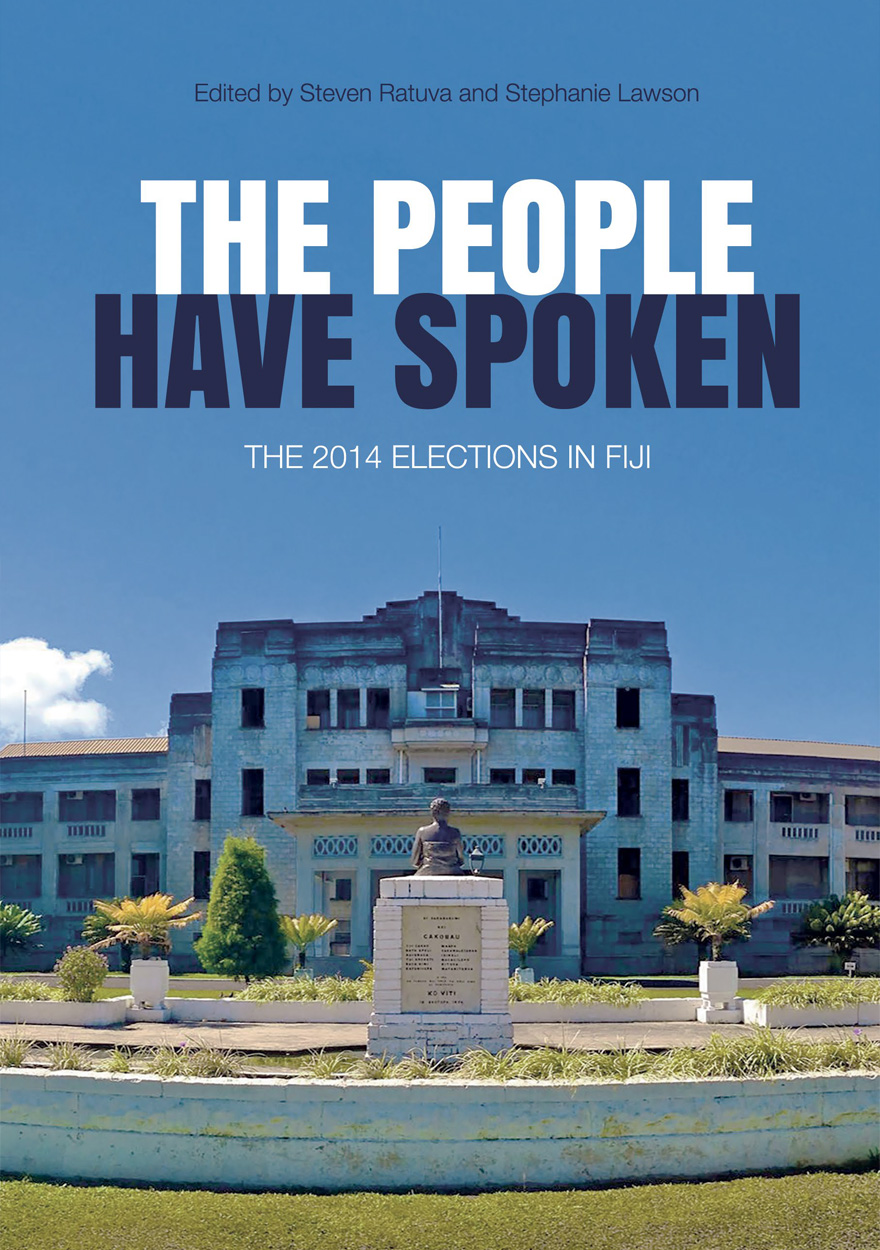
The people have spoken »
The 2014 elections in Fiji
Edited by: Steven Ratuva, Stephanie Lawson
Publication date: March 2016
The September 2014 elections in Fiji was one of the most anticipated in the history of the country, coming after eight years of military rule and under a radically new constitution that introduced a system of proportional representative (PR) and without any reserved communal seats. The election was won overwhelmingly by FijiFirst, a party formed by 2006 coup leader Frank Bainimarama. He subsequently embarked on a process of shifting the political configuration of Fijian politics from inter-ethnic to trans-ethnic mobilisation. The shift has not been easy in terms of changing people’s perceptions and may face some challenges in the longer term, despite Bainimarama’s clear victory in the polls. Ethnic consciousness has the capacity to become re‑articulated in different forms and to seek new opportunities for expression. This book explores these and other issues surrounding the 2014 Fiji elections in a collection of articles written from varied political, intellectual and ideological positions.
Professional Social Work in Australia »
Authored by: R.J. Lawrence
Publication date: February 2016
This is an unchanged republication of the first historical account of the social work profession in Australia. It traces the development of social work education and professional social work in the larger, more industrialised societies overseas before the same developments began in Australia in the late 1920s, and it notes the part played by overseas influence in the subsequent 30-odd years. The book concentrates on the development of training bodies and their courses, the spread of qualified social workers into various fields of employment in Australia’s expanding health and welfare services, and the growth of professional associations and their programmes. The author assesses the occupational group in terms of accepted attitudes towards the established professions. He concludes with a discussion of major contemporary issues facing the Australian social work profession.

Merici- Ursula Hall Academic Journal: Volume 1, 2015 »
Publication date: February 2016
Merici is the combined works of undergraduate authors at Ursula Hall. Merici contains research and analysis from a range of disciplines and is thoroughly reviewed by ANU academics to ensure the showcasing of the best Ursula Hall has to offer.
Download for free
Not available for purchase

Confronting Fiji Futures »
Edited by: A. Haroon Akram-Lodhi
Publication date: January 2016
Fiji, post-independence, has seen several governments, two military coups and, amidst sweeping social, economic and political changes, the presence of divisive identity politics in its journey towards a united, collective Fiji community.
This republished edition of Confronting Fiji Futures takes in these landmark events and eventualities, and aims at a forward-looking assessment of the realities facing Fiji in the present and the future. It focuses on the period of the coups up to and including the 1999 general elections, when an explicitly multiethnic party won government in a surprise landslide result.
This book is the result of a collaborative research project based at the Institute of Social Studies, The Hague, in the Netherlands — an institution with a long tradition of collaborative teaching, research and advisory services in the South Pacific region. It aims to present a range of relevant issues from a number of vantage points. It has brought together a strong diversity of authors led by A. Haroon Akram-Lodhi, including John Cameron, Ganesh Chand, Martin Doornbos, Yash Ghai, Holger Korth, Sunil Kumar, Biman Prasad, Jacqueline Leckie, Satendra Prasad, Steve Ratuva, Robbie Robertson, Ardeshir Sepehri and William Sutherland.

In Defence of Country »
Life Stories of Aboriginal and Torres Strait Islander Servicemen and Women
Authored by: Noah Riseman
Publication date: January 2016
Aboriginal and Torres Strait Islander people have been protecting country since time immemorial. One way they have continued these traditions in recent times is through service in the Australian military, both overseas and within Australia. In Defence of Country presents a selection of life stories of Aboriginal and Torres Strait Islander ex-servicemen and women who served in the Australian Army, Navy and Air Force after World War Two. In their own words, participants discuss a range of issues including why they joined up; racial discrimination; the Stolen Generations; leadership; discipline; family; war and peace; education and skills development; community advocacy; and their hopes for the future of Indigenous Australia. Individually and collectively, the life stories in this book highlight the many contributions that Aboriginal and Torres Strait Islander servicemen and women have made, and continue to make, in defence of country.
For more information on Aboriginal History Inc. please visit aboriginalhistory.org.au.

Experiments in self-determination »
Histories of the outstation movement in Australia
Edited by: Nicolas Peterson, Fred Myers
Publication date: January 2016
Outstations, which dramatically increased in numbers in the 1970s, are small, decentralised and relatively permanent communities of kin established by Aboriginal people on land that has social, cultural or economic significance to them. In 2015 they yet again came under attack, this time as an expensive lifestyle choice that can no longer be supported by state governments. Yet outstations are the original, and most striking, manifestation of remote-area Aboriginal people’s aspirations for self-determination, and of the life projects by which they seek, and have sought, autonomy in deciding the meaning of their life independently of projects promoted by the state and market. They are not simply projects of isolation from outside influences, as they have sometimes been characterised, but attempts by people to take control of the course of their lives. In the sometimes acrimonious debates about outstations, the lived experiences, motivations and histories of existing communities are missing. For this reason, we invited a number of anthropological witnesses to the early period in which outstations gained a purchase in remote Australia to provide accounts of what these communities were like, and what their residents’ aspirations and experiences were. Our hope is that these closer-to-the-ground accounts provide insight into, and understanding of, what Indigenous aspirations were in the establishment and organisation of these communities.
This volume will be a great addition not only to the origins and history of outstations, but in light of the closing of over 100 Aboriginal communities in Western Australia, it should be a required bedtime reading for all politicians across Australia. The contributors do not simply concentrate on the so-called outstations movement of the 1970s, but rather help the reader understand why in the 1930s, ‘40s, ‘50s, and ‘60s, Aboriginal people moved away from cattle stations, missions and settlements to reconstruct their moral compass in settings which made more contemporaneous sense, not only to them but often to the whites who were there as well.
—Professor Francoise Dussart, University of Connecticut.

Burgmann Journal- Research Debate Opinion: Issue 4, 2015 »
Publication date: December 2015
Burgmann Journal is an interdisciplinary, peer-reviewed publication of collected works of research, debate and opinion from residents and alumni of Burgmann College designed to engage and stimulate the wider community.
Download for free
Not available for purchase
Agenda - A Journal of Policy Analysis and Reform: Volume 22, Number 1, 2015 »
Edited by: William Coleman
Publication date: December 2015
Agenda is a refereed, ECONLIT-indexed and RePEc-listed journal of the College of Business and Economics, The Australian National University. Launched in 1994, Agenda provides a forum for debate on public policy, mainly (but not exclusively) in Australia and New Zealand. It deals largely with economic issues but gives space to social and legal policy and also to the moral and philosophical foundations and implications of policy.
Subscribe to the Agenda Alerting service if you wish to be advised on forthcoming or new issues.
Download for free
Not available for purchase
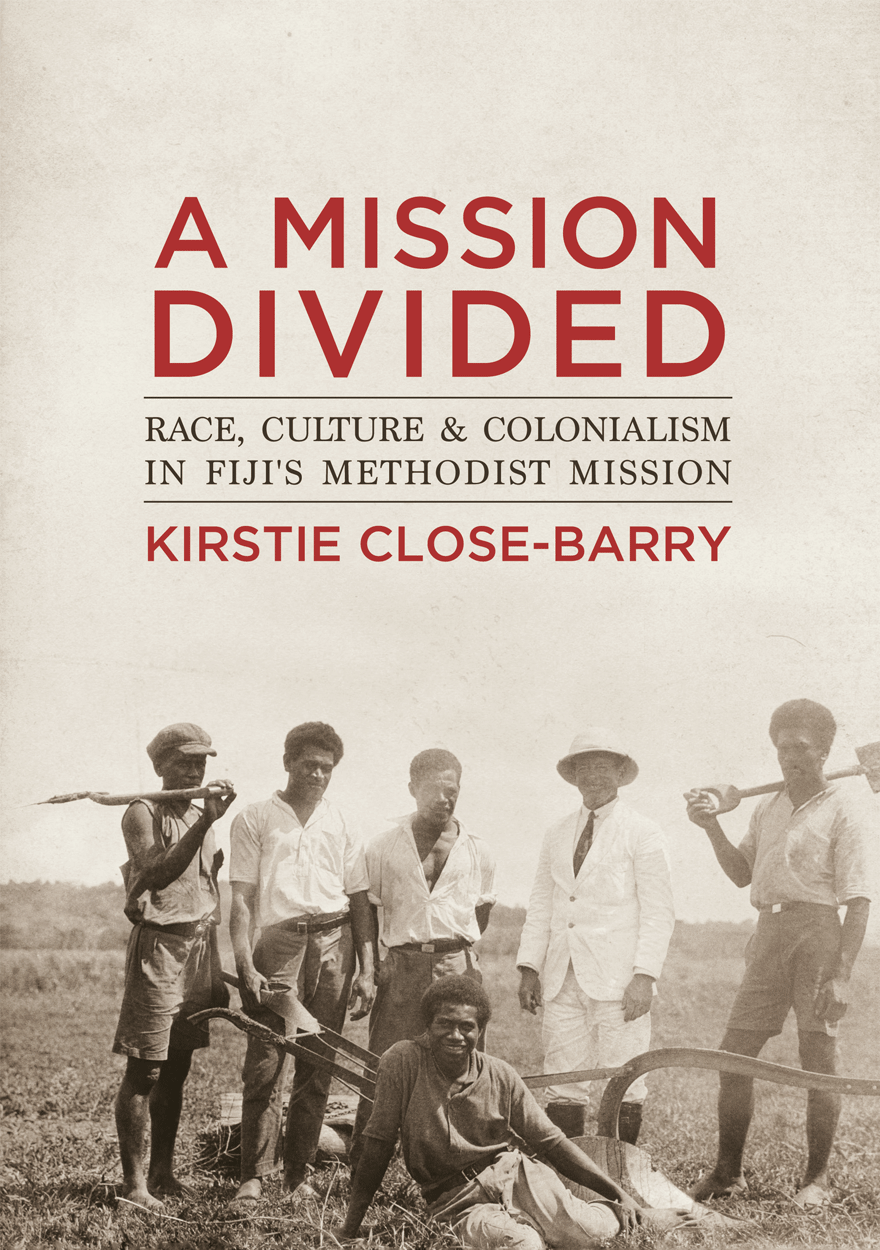
A Mission Divided »
Race, Culture and Colonialism in Fiji’s Methodist Mission
Authored by: Dr Kirstie Close-Barry
Publication date: December 2015
This book provides insight into the long process of decolonisation within the Methodist Overseas Missions of Australasia, a colonial institution that operated in the British colony of Fiji. The mission was a site of work for Europeans, Fijians and Indo-Fijians, but each community operated separately, as the mission was divided along ethnic lines in 1901. This book outlines the colonial concepts of race and culture, as well as antagonism over land and labour, that were used to justify this separation. Recounting the stories told by the mission’s leadership, including missionaries and ministers, to its grassroots membership, this book draws on archival and ethnographic research to reveal the emergence of ethno-nationalisms in Fiji, the legacies of which are still being managed in the post-colonial state today.
Analysing in part the story of her own ancestors, Kirstie Barry develops a fascinating account of the relationship between Christian proselytization and Pacific nationalism, showing how missionaries reinforced racial divisions between Fijian and Indo-Fijian even as they deplored them. Negotiating the intersections between evangelisation, anthropology and colonial governance, this is a book with resonance well beyond its Fijian setting.
– Professor Alan Lester, University of Sussex
This thoroughly researched and finely crafted book unwraps and finely illustrates the interwoven layers of evolving complexity in different interpretations of ideals and debates on race, culture, colonialism and independence that informed the way the Methodist Mission was run in Fiji. It describes the human personalities and practicalities, interconnected at local, regional and global levels, which influenced the shaping of the Mission and the independent Methodist Church in Fiji. It documents the influence of evolving anthropological theories and ecumenical theological understandings of culture on mission practice. The book’s rich sources enhance our understanding of the complex history of ethnic relations in Fiji, helping to explain why ethnic divisive thinking remains a challenge.
– Jacqueline Ryle, University of the South Pacific
A beautifully researched study of the transnational impact of South Asian bodies on nationalisms and church devolution in Fiji, and an important resource for empire studies as a whole.’
– Professor Jane Samson, University of Alberta, Canada
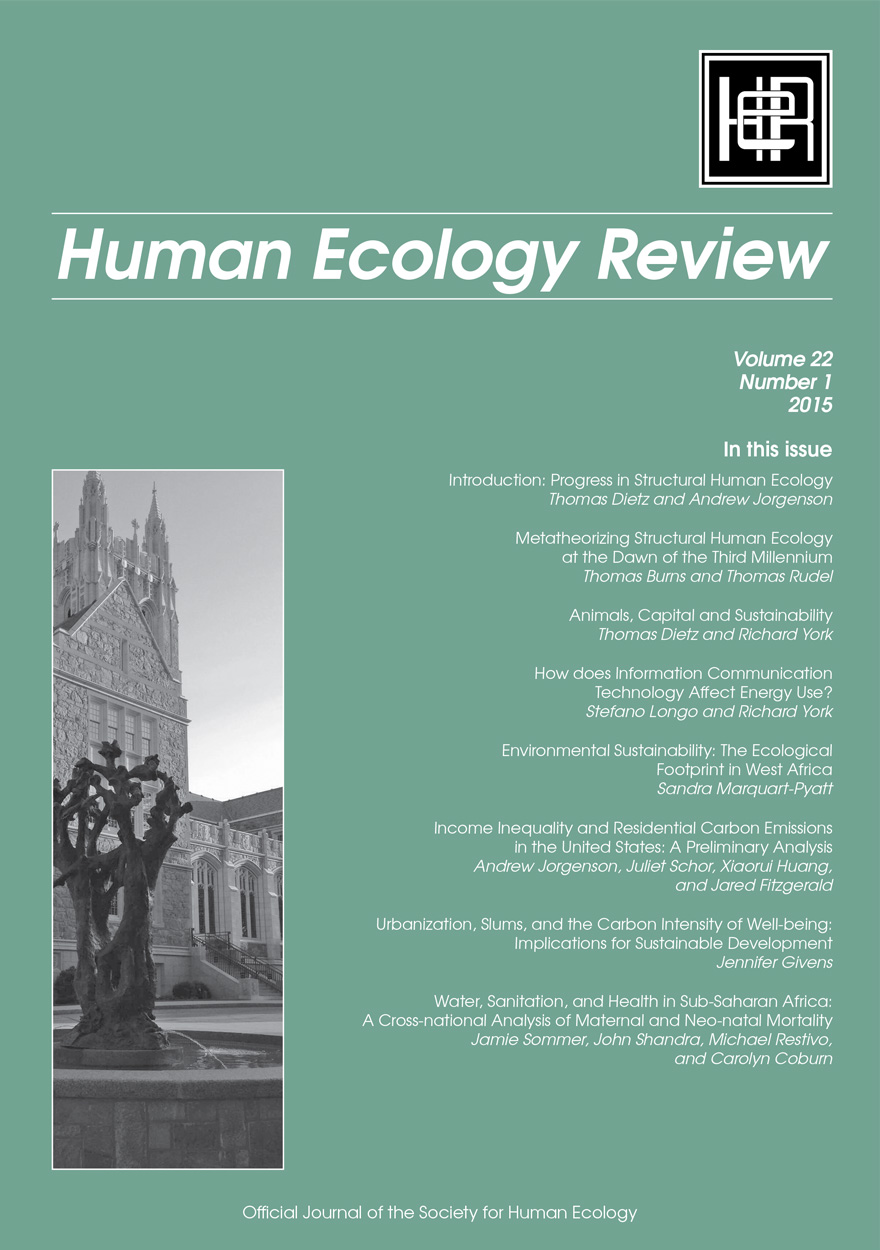
Human Ecology Review: Volume 22, Number 1 »
Publication date: December 2015
Human Ecology Review is a semi-annual journal that publishes peer-reviewed interdisciplinary research on all aspects of human–environment interactions (Research in Human Ecology). The journal also publishes essays, discussion papers, dialogue, and commentary on special topics relevant to human ecology (Human Ecology Forum), book reviews (Contemporary Human Ecology), and letters, announcements, and other items of interest (Human Ecology Bulletin). Human Ecology Review also publishes an occasional paper series in the Philosophy of Human Ecology and Social–Environmental Sustainability.
Download for free
Not available for purchase