



Search titles
Displaying results 471 to 480 of 1165.

Reading Embraced by Australia »
Hiroshima Modules 1 and 2
Authored by: Carol Hayes, Yuki Itani-Adams
Publication date: December 2016
Hiroshima Modules 1 and 2 provide a first-hand account of surviving Hiroshima's atomic bomb.
This eText is the first volume of an advanced Japanese language comprehension series aimed firstly at improving Japanese language skills, and secondly at introducing readers to a first-hand account of Australia and Japan’s shared WWII and post-WWII history. Made up of two modules, this eText includes audio recordings of the text, movie files of recorded interviews with Teruko Blair and interactive comprehension quiz questions to help readers engage with the Japanese text.
The story is drawn from war bride and Hiroshima survivor Mrs Teruko Blair's 1991 Japanese memoir, Embraced by Australia (『オーストラリアに抱かれて』), published by Asahi TV Press.
Hiroshima Modules 1 and 2 take readers on a journey behind the eyes of then 20-year-old Teruko. Module 1 covers only a few days in Teruko’s life, in the lead up to the bombing, the horrific impact of the bomb and how she and her family just managed to escape the black rain. Module 2 continues on from Module 1, describing how Teruko and her family survived by managing to escape across the Ōta River to a friend’s farm. The story ends with the survival of all four children and both their parents, which is nothing short of miraculous.
Download for free
Not available for purchase
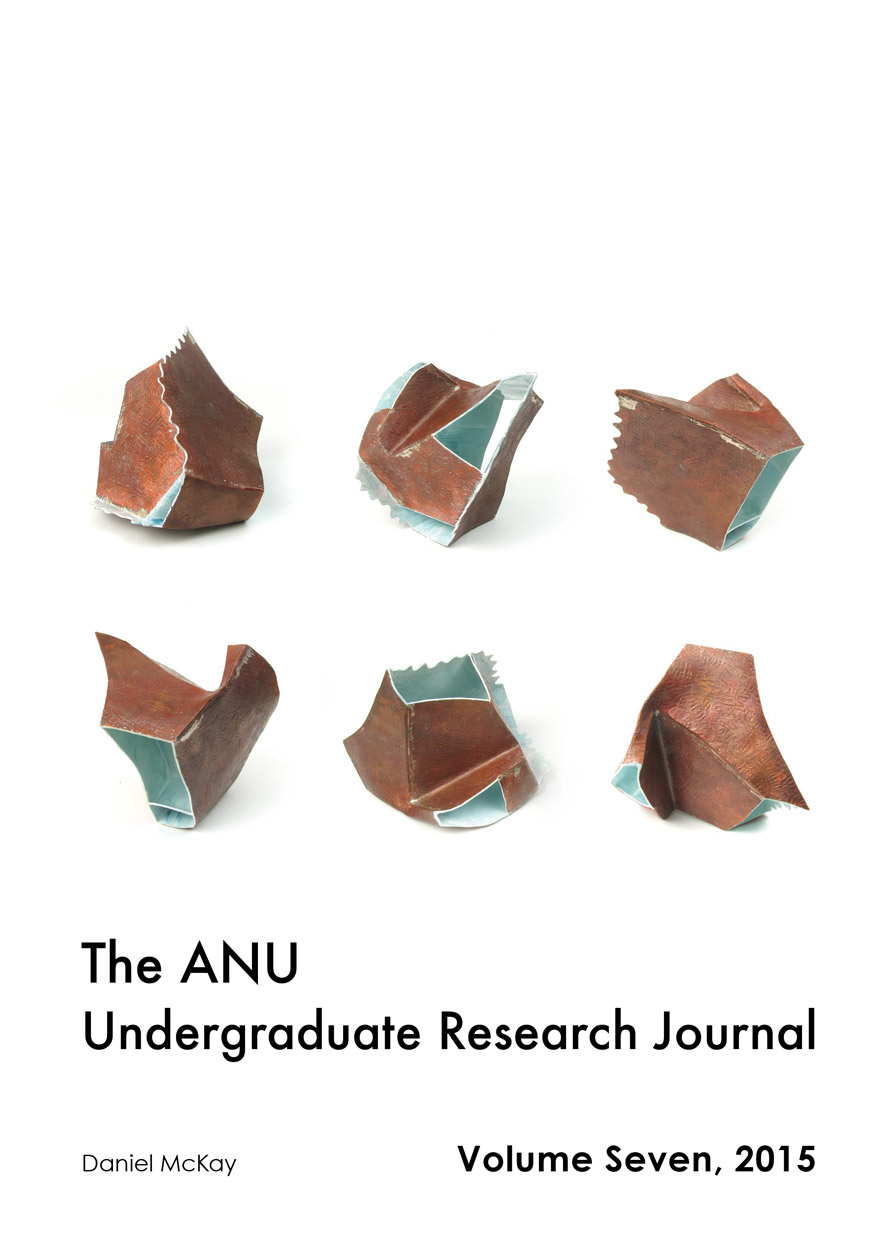
ANU Undergraduate Research Journal: Volume Seven, 2015 »
Publication date: December 2016
The ANU Undergraduate Research Journal presents outstanding essays taken from ANU undergraduate essay submissions. The breadth and depth of the articles chosen for publication by the editorial team and reviewed by leading ANU academics demonstrates the quality and research potential of the undergraduate talent being nurtured at ANU across a diverse range of fields.
Established in 2008, AURJ was designed to give students a unique opportunity to publish their undergraduate work; it is a peer-reviewed journal managed by a team of postgraduate student editors, with guidance from the staff of the Office of the Dean of Students.
Download for free
Not available for purchase

Deep Crustal Seismic Reflection Profiling »
Australia 1978–2015
Authored by: Brian Kennett, E. Saygin, T. Fomin, Richard Blewett
Publication date: November 2016
Deep Crustal Seismic Reflection Profiling: Australia 1978–2015 presents the full suite of reflection profiles penetrating the whole crust carried in Australia by Geoscience Australia and various partners.
The set of reflection data comprises over 16,000 km of coverage across the whole continent, and provides an insight into the variations in crustal architecture in the varied geological domains. Each reflection profile is presented at approximately true scale with up to 220 km of profile per page and overlap between pages. Each reflection section is accompanied by a geological strip map showing the configuration of the line superimposed on 1:1M geology. The compilation includes a suite of large-scale reflection transects groups of 1,000 km or more that link across major geological provinces, and an extensive bibliography of reports and relevant publications.

Family Experiments »
Middle-class, professional families in Australia and New Zealand c. 1880–1920
Authored by: Shelley Richardson
Publication date: November 2016
Family Experiments explores the forms and undertakings of ‘family’ that prevailed among British professionals who migrated to Australia and New Zealand in the late nineteenth century. Their attempts to establish and define ‘family’ in Australasian, suburban environments reveal how the Victorian theory of ‘separate spheres’ could take a variety of forms in the new world setting.
The attitudes and assumptions that shaped these family experiments may be placed on a continuum that extends from John Ruskin’s concept of evangelical motherhood to John Stuart Mill’s rational secularism. Central to their thinking was a belief in the power of education to produce civilised and humane individuals who, as useful citizens, would individually and in concert nurture a better society.
Such ideas pushed them to the forefront of colonial liberalism. The pursuit of higher education for their daughters merged with and, in some respects, influenced first-wave colonial feminism. They became the first generation of colonial, middle-class parents to grapple not only with the problem of shaping careers for their sons but also, and more frustratingly, what graduate daughters might do next.

Indigenous Data Sovereignty »
Toward an agenda
Edited by: Tahu Kukutai, John Taylor
Publication date: November 2016
As the global ‘data revolution’ accelerates, how can the data rights and interests of indigenous peoples be secured? Premised on the United Nations Declaration on the Rights of Indigenous Peoples, this book argues that indigenous peoples have inherent and inalienable rights relating to the collection, ownership and application of data about them, and about their lifeways and territories. As the first book to focus on indigenous data sovereignty, it asks: what does data sovereignty mean for indigenous peoples, and how is it being used in their pursuit of self-determination?
The varied group of mostly indigenous contributors theorise and conceptualise this fast-emerging field and present case studies that illustrate the challenges and opportunities involved. These range from indigenous communities grappling with issues of identity, governance and development, to national governments and NGOs seeking to formulate a response to indigenous demands for data ownership. While the book is focused on the CANZUS states of Canada, Australia, Aotearoa/New Zealand and the United States, much of the content and discussion will be of interest and practical value to a broader global audience.
‘A debate-shaping book … it speaks to a fast-emerging field; it has a lot of important things to say; and the timing is right.’
— Stephen Cornell, Professor of Sociology and Faculty Chair of the Native Nations Institute, University of Arizona
‘The effort … in this book to theorise and conceptualise data sovereignty and its links to the realisation of the rights of indigenous peoples is pioneering and laudable.’
— Victoria Tauli-Corpuz, UN Special Rapporteur on the Rights of Indigenous Peoples, Baguio City, Philippines
Sharpening the Sword of State »
Building executive capacities in the public services of the Asia-Pacific
Edited by: Andrew Podger, John Wanna
Publication date: November 2016
Sharpening the Sword of State explores the various ways in which 10 jurisdictions in the Asia-Pacific enhance their administrative capabilities through training and executive development. It traces how modern governments across this region look to develop their public services and public sector organisations in the face of rapid global change. For many governments there is a delicate balance between the public interest in promoting change and capacity enhancement across the public service, and the temptation to micro-manage agencies and be complacent about challenging the status quo. There is a recognition in the countries studied that training and executive development is a crucial investment in human capital but is also couched in a much wider context of public service recruitment, patterns of entry and retention, promotion, executive appointment and career development. This empirical volume, authored by academics and practitioners, is one of the first to chart these comparative differences and provide fresh perspectives to enable learning from international experiences.

Reluctant Representatives »
Blackfella bureaucrats speak in Australia’s north
Authored by: Elizabeth Ganter
Publication date: November 2016
‘How can you make decisions about Aboriginal people when you can’t even talk to the people you’ve got here that are blackfellas?’ So ‘Sarah’, a senior Aboriginal public servant, imagines a conversation with the Northern Territory Public Service. Her question suggests tensions for Aboriginal and Torres Strait Islanders who have accepted the long-standing invitation to join the ranks of the public service.
Reluctant Representatives gives us a rare glimpse into the working world of the individuals behind the Indigenous public sector employment statistics. This empathetic exposé of the challenges of representative bureaucracy draws on interviews with Aboriginal and Torres Strait Islander Australians who have tried making it work. Through Ganter’s engaging narration, we learn that the mere presence of Aboriginal and Torres Strait Islanders in the public service is not enough. If bureaucracies are to represent the communities they serve, Aboriginal and Torres Strait Islander public servants need to be heard and need to know their people are heard.

East Asia Forum Quarterly: Volume 8, Number 4, 2016 »
Publication date: November 2016
East Asia Forum Quarterly grew out of East Asia Forum (EAF) online, which has developed a reputation for providing a platform for the best in Asian analysis, research and policy comment on the Asia Pacific region in world affairs. EAFQ aims to provide a further window onto research in the leading research institutes in Asia and to provide expert comment on current developments within the region. The East Asia Forum Quarterly, like East Asia Forum online, is an initiative of the East Asia Forum (EAF) and its host organisation, the East Asian Bureau of Economic Research (EABER) in the Crawford School of Economics and Government in the College of Asia & the Pacific at The Australian National University.
Download for free
Not available for purchase

The Lion that Didn't Roar »
Can the Kimberley Process Stop the Blood Diamonds Trade?
Authored by: Nigel Davidson
Publication date: October 2016
In 2017 it will be Australia’s turn to chair the Kimberley Process Certification Scheme (KP), an international organisation set up to regulate the trade in diamonds. Diamonds are a symbol of love, purchased to celebrate marriage, and it is therefore deeply ironic that the diamond trade has become linked with warfare and human rights violations committed in African producer countries such as Sierra Leone, the Democratic Republic of Congo and, more recently, Zimbabwe and Angola. In their quest for diamonds, or by using diamonds to purchase weapons, armed groups in these countries have engaged in recruiting child soldiers, amputating limbs, and committing rape and murder. In response to the problem, the international community, non-governmental organisations and key industry players such as De Beers combined forces to create the Kimberley Process in 2002. The KP uses an export certificate system to distinguish the legitimate rough diamond trade from so-called ‘blood diamonds’, which are also known as ‘conflict diamonds’. This book considers the extent to which the KP, supported by other agencies at the international and national levels, has been effective in achieving its mandate. In so doing, it presents an original model derived from the domain of regulatory theory, the Dual Networked Pyramid, as a means of describing the operation of the system and suggesting possible improvements that might be made to it.
Nigel Davidson spoke with 936 ABC Hobart about what Australia can do to help stop blood diamonds. Listen to the full interview here.

A Difficult Neighbourhood »
Essays on Russia and East-Central Europe since World War II
Authored by: John Besemeres
Publication date: October 2016
Through a series of essays on key events in recent years in Russia, the western ex-republics of the USSR and the countries of the one-time Warsaw Pact, John Besemeres seeks to illuminate the domestic politics of the most important states, as well as Moscow’s relations with all of them. At the outset, he takes some backward glances at the violent suppression of national life in the ‘bloodlands’ of Europe during World War II by the Stalinist and Nazi regimes, which helps to explain much about the region’s dynamics since. His concern throughout is that a large area of Europe with a combined population well in excess of Russia’s could again be consigned by the West to Moscow’s care, not this time by more and less malign forms of collusion, but by distracted negligence or incomprehension.
‘This is a wonderful collection of essays from a leading Eastern Europe specialist. John Besemeres brings a lifetime of experience, profound insights, and an incisive style to subjects ranging from wartime and post-war Poland through contemporary Ukraine to Putin’s Russia. At a time when doublespeak has become the new normal, his refreshing honesty has never been in greater need.’
— Bobo Lo
This publication was awarded a Centre for European Studies Publication Prize in 2015. The prize covers the cost of professional copyediting.