



Search titles
Displaying results 391 to 400 of 572.
Power, Culture, Economy »
Indigenous Australians and Mining
Edited by: Jon Altman, David Martin
Publication date: August 2009
Research over the past decade in health, employment, life expectancy, child mortality, and household income has confirmed that Indigenous Australians are still Australia’s most disadvantaged group. Those residing in communities in regional and remote Australia are further disadvantaged because of the limited formal economic opportunities there. In these areas mining developments may be the major—and sometimes the only—contributors to regional economic development. However Indigenous communities have gained only relatively limited long-term economic development benefits from mining activity on land that they own or over which they have property rights of varying significance. Furthermore, while Indigenous people may place high value on realising particular non-economic benefits from mining agreements, there may be only limited capacity to deliver such benefits.
This collection of papers focuses on three large, ongoing mining operations in Queensland, Western Australia and the Northern Territory under two statutory regimes—the Aboriginal Land Rights (Northern Territory) Act 1976 and the Native Title Act 1993. The authors outline the institutional basis to greater industry involvement while describing and analysing the best practice principles that can be utilised both by companies and Indigenous community organisations. The research addresses questions such as:
What factors underlie successful investment in community relations and associated agreement governance and benefit packages for Indigenous communities?
How are economic and non-economic flows monitored?
What are the values and aspirations which Indigenous people may bring to bear in their engagement with mining developments?
What more should companies and government do to develop the capacity and sustainability of local Indigenous organisations?
What mining company strategies build community capacity to deal with impacts of mining? Are these adequate?
How to prepare for sustainable futures for Indigenous Australians after mine closure?
This research was conducted under an Australian Research Council Linkage Project, with Rio Tinto and the Committee for Economic Development of Australia as Industry Partners.

Archaeological Science Under a Microscope »
Studies in Residue and Ancient DNA Analysis in Honour of Thomas H. Loy
Edited by: Michael Haslam, Gail Robertson, Alison Crowther, Sue Nugent, Luke Kirkwood
Publication date: July 2009
These highly varied studies, spanning the world, demonstrate how much modern analyses of microscopic traces on artifacts are altering our perceptions of the past. Ranging from early humans to modern kings, from ancient Australian spears or Mayan pots to recent Maori cloaks, the contributions demonstrate how starches, raphides, hair, blood, feathers, resin and DNA have become essential elements in archaeology’s modern arsenal for reconstructing the daily, spiritual, and challenging aspects of ancient lives and for understanding human evolution. The book is a fitting tribute to Tom Loy, the pioneer of residue studies and gifted teacher who inspired and mentored these exciting projects.

The Dilemmas of Engagement »
The Role of Consultation in Governance
Authored by: Jenny Stewart
Publication date: June 2009
‘Consultation’ has become something of a mantra in contemporary governance. Governments well understand that policy occurs in a highly contestable environment in which there are multiple, and often competing interests. They well recognise the political imperative to ‘engage’ stakeholders in order to manage potential conflict and, hopefully, obtain acceptance for their policies and programs. As a result, politicians and public officials frequently emphasise the need for consultation as an essential element of the deliberative processes underpinning the development of policy or the implementation of programs and services. But, moving beyond the rhetoric of consultation and engagement, how well is it done? In this monograph, Professor Jenny Stewart maps out the principal approaches used by governments to consult with and engage affected communities of interest. Stewart critically assesses the available literature and draws directly upon the experiences of political actors, bureaucrats and community sector organisations in order to identify the ‘good, bad, and the ugly’ of engagement. Through a judicious use of selected case studies, Stewart distils the essential dilemmas and contradictions inherent in many consultation strategies and highlights their relative strengths and weaknesses. This monograph is a probing and dispassionate analysis of the rationales, methodologies and outcomes of consultation and engagement. It is not intended to be a ‘cookbook’ or a ‘how to’ manual for those consulting or the consulted. Nevertheless, there is much here for the policy practitioner, the researcher and members of those ‘communities of interest’ who might, one day, find themselves the target of engagement.

The Role of Departmental Secretaries »
Personal reflections on the breadth of responsibilities today
Authored by: Andrew Podger
Publication date: June 2009
Andrew Podger’s monograph, The Role of Departmental Secretaries, Personal reflections on the breadth of responsibilities today, is an important contribution to the broader public policy discourse in Australia. Andrew has been, at times, an unflinching commentator on issues of bureaucratic performance, accountability and responsiveness to government. Andrew’s reflections are drawn from his own experiences within the inner circle of Australian policy-making. In this monograph, he presents a highly nuanced portrait of the role of Commonwealth departmental secretaries. Although a ‘player’ himself at key moments in recent policy history, Andrew is a dispassionate and thoughtful observer of events. This is not merely a memoir: this work is rich in analysis and Andrew offers a number of ‘lessons learned’ to be heeded (or not) by the present and future generations of policy practitioners.

Agenda - A Journal of Policy Analysis and Reform: Volume 16, Number 2, 2009 »
Edited by: William Coleman
Publication date: June 2009
Agenda is a refereed, ECONLIT-indexed and RePEc-listed journal of the College of Business and Economics, The Australian National University. Launched in 1994, Agenda provides a forum for debate on public policy, mainly (but not exclusively) in Australia and New Zealand. It deals largely with economic issues but gives space to social and legal policy and also to the moral and philosophical foundations and implications of policy.
Subscribe to the Agenda Alerting service if you wish to be advised on forthcoming or new issues.
Download for free
Not available for purchase

Critical Reflections on Australian Public Policy »
Selected Essays
Edited by: John Wanna
Publication date: May 2009
This collection of ‘critical reflections’ on Australian public policy offers a valuable contribution to public discussion of important political and policy issues facing our nation and society. These essays are important not only because of the reputation and position of the various contributors, but because they are incredibly ‘content rich’ and brimming with new ideas.

Australian Humanities Review: Issue 46, 2009 »
Edited by: Monique Rooney, Russell Smith
Publication date: May 2009
Australian Humanities Review is a peer-reviewed interdisciplinary journal featuring articles, essays and reviews focusing on a wide array of topics related to literature, culture, history and politics.
Download for free
Not available for purchase
Tracking Rural Change »
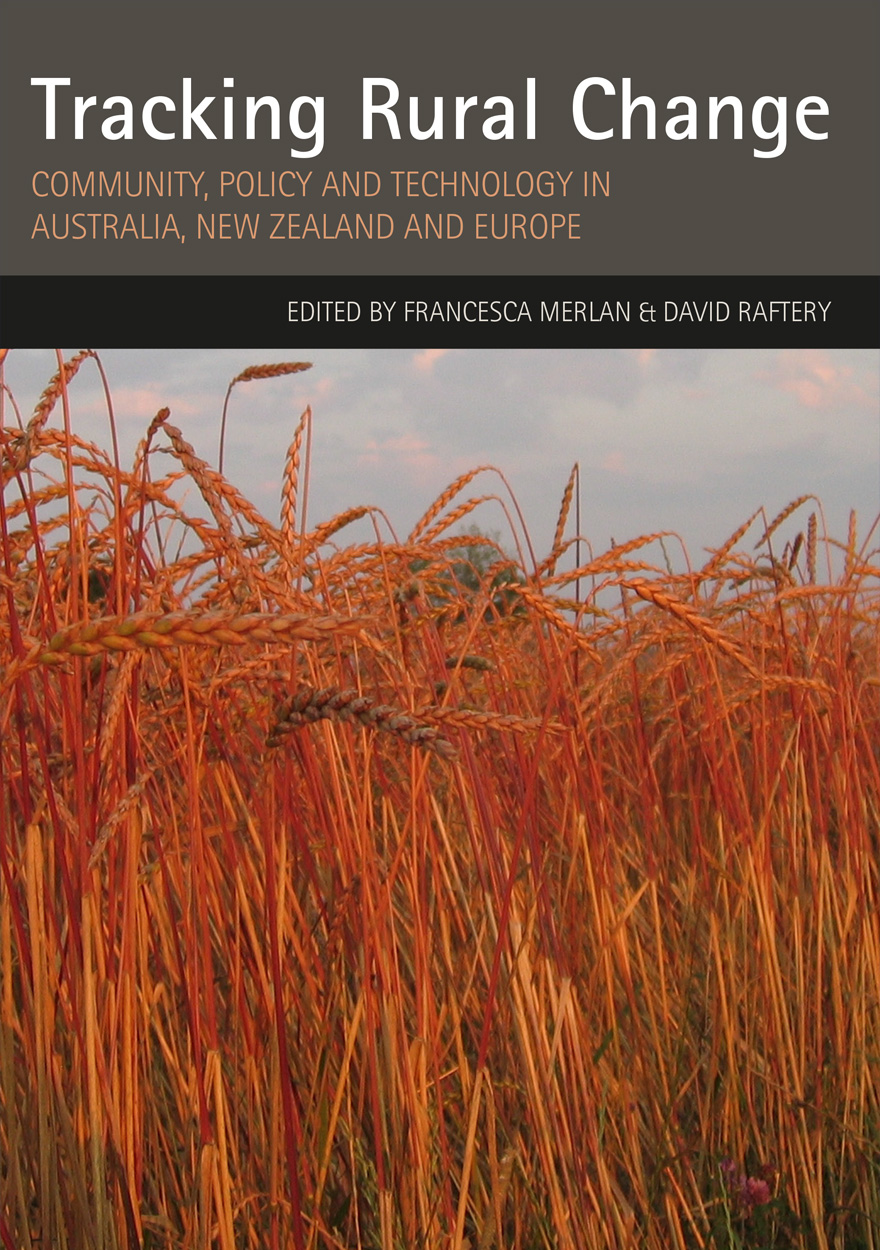
Community, Policy and Technology in Australia, New Zealand and Europe
Edited by: Francesca Merlan, David Raftery
Publication date: April 2009
A key, intensifying change affecting rural areas in the last few decades has been a decline in the proportion of national populations whose principal livelihood is farming. The corresponding re-distribution of population has typically resulted in a net population loss to rural areas, and diversification of rural activity. The corporatization and technological modification of food production has prompted new policy challenges, and has bound rural and urban populations together in new relationships articulated in moral discourses of custodianship, food safety, and sustainability. Contributors to this volume came together in the attempt to stimulate collective insight into trends of rural change in Australia, New Zealand and Europe. The first two countries have been characterised by avowedly `neoliberal’ rural policy – with considerable departures from it in practice; Europe, on the other hand, by a mix of policy measures which attempt to integrate land management and sustainability, diversification and maintenance of a competitive farming sector within an overarching policy framework more overtly, though only partially, oriented towards sustaining rural society.
Aiming to build on research relating to the character of rural transitions, this volume offers substantive and critical contributions to the understanding of the sources of unpredictability, instability, and continuity, that underpin rural transition. The papers explore changes and continuities in policy, the governance of rural spaces, technological developments relating to rural areas and populations, and social forms of subjectivation and participation in increasingly diverse rural settings.

Agenda - A Journal of Policy Analysis and Reform: Volume 16, Number 1, 2009 »
Edited by: William Coleman
Publication date: April 2009
Agenda is a refereed, ECONLIT-indexed and RePEc-listed journal of the College of Business and Economics, The Australian National University. Launched in 1994, Agenda provides a forum for debate on public policy, mainly (but not exclusively) in Australia and New Zealand. It deals largely with economic issues but gives space to social and legal policy and also to the moral and philosophical foundations and implications of policy.
Subscribe to the Agenda Alerting service if you wish to be advised on forthcoming or new issues.
Download for free
Not available for purchase

Howard's Long March »
The Strategic Depiction of China in Howard Government Policy, 1996–2006
Authored by: Roy Campbell McDowall
Publication date: March 2009
Australia’s strategic depiction of China has assumed increased importance as it attempts to harmonise economic interests (focusing on China) with security interests (primarily the United States). In this period of strategic transition, how Australia incorporates the rise of China into its existing security commitment under ANZUS has become a delicate issue. This investigation follows the intriguing evolution of the Howard Government’s depictions of China, and reveals a complex and calculated strategy that successfully transformed a potentially volatile conflict of interests into a functional foreign policy.