



Search titles
Displaying results 311 to 320 of 572.

A Trial Separation »
Australia and the Decolonisation of Papua New Guinea
Authored by: Donald Denoon
Publication date: May 2012
When it came in September 1975, Papua New Guinea’s independence was marked by both anxiety and elation. In the euphoric aftermath, decolonisation was declared a triumph and immediate events seemed to justify that confidence. By the 1990s, however, events had taken a turn for the worse and there were doubts about the capacity of the State to function. Before independence, Papua New Guinea was an Australian Territory. Responsibility lay with a minister in Canberra and services were provided by Commonwealth agencies. In 1973, Prime Minister Gough Whitlam declared that independence should be achieved within two years. While Australians were united in their desire to decolonise, many Papua New Guineans were nervous of independence.
This superlative history presents the full story of the ‘trial separation’ of Australia and Papua New Guinea, concluding that — given the intertwined history, geography and economies of the two neighbours — the decolonisation project of ‘independence’ is still a work in progress.

East Asia Forum Quarterly: Volume 4, Number 2, 2012 »
Publication date: May 2012
East Asia Forum Quarterly grew out of East Asia Forum (EAF) online, which has developed a reputation for providing a platform for the best in Asian analysis, research and policy comment on the Asia Pacific region in world affairs. EAFQ aims to provide a further window onto research in the leading research institutes in Asia and to provide expert comment on current developments within the region. The East Asia Forum Quarterly, like East Asia Forum online, is an initiative of the East Asia Forum (EAF) and its host organisation, the East Asian Bureau of Economic Research (EABER) in the Crawford School of Economics and Government in the College of Asia & the Pacific at The Australian National University.
Download for free
Not available for purchase

With the Benefit of Hindsight »
Valedictory Reflections from Departmental Secretaries, 2004–11
Publication date: April 2012
Secretaries of government departments in Australia are the bureaucratic leaders of their generation. They are ambitious, highly-talented executives who have risen to the very pinnacle of their chosen vocation – public service to the Australian nation – usually after having spent most, if not all, of their professional careers dedicated to the public service. They serve governments as their top advisers and in policy terms are often some of the most important decision-makers in the country.
This collection brings together the valedictory speeches and essays from a departing group of secretaries (and one or two other equivalent agency heads) who left the Australian Public Service between 2004 and 2011. Over this period of time it gradually became accepted that departing secretaries and heads of significant agencies would present a valedictory address to their peers at a public farewell function. The first two speeches in this collection were initiated informally and given at functions organised by their agencies; in 2005 the process was formalised with the Australian Public Service Commission acting as organiser.
These contributions contain reflections, commentaries, occasional fond memories or key turning-points in careers, critiques of changes that have occurred and an outline of the remaining challenges their successors will face as the public administrators of tomorrow.
From the outset it is clear that there is no uniform message, no single narrative levelled either in praise or in criticism, other than pride in the public service and strong belief in the contribution it makes to the Australian community. They have their own personal ‘takes’ on how the public service looks to them, on its performance and on the challenges confronting public administration into the future. Most spend some time looking back, reflecting on the extent of change that has occurred over the length of their careers; but equally importantly they look forward, anticipating future policy dilemmas and capacity challenges.
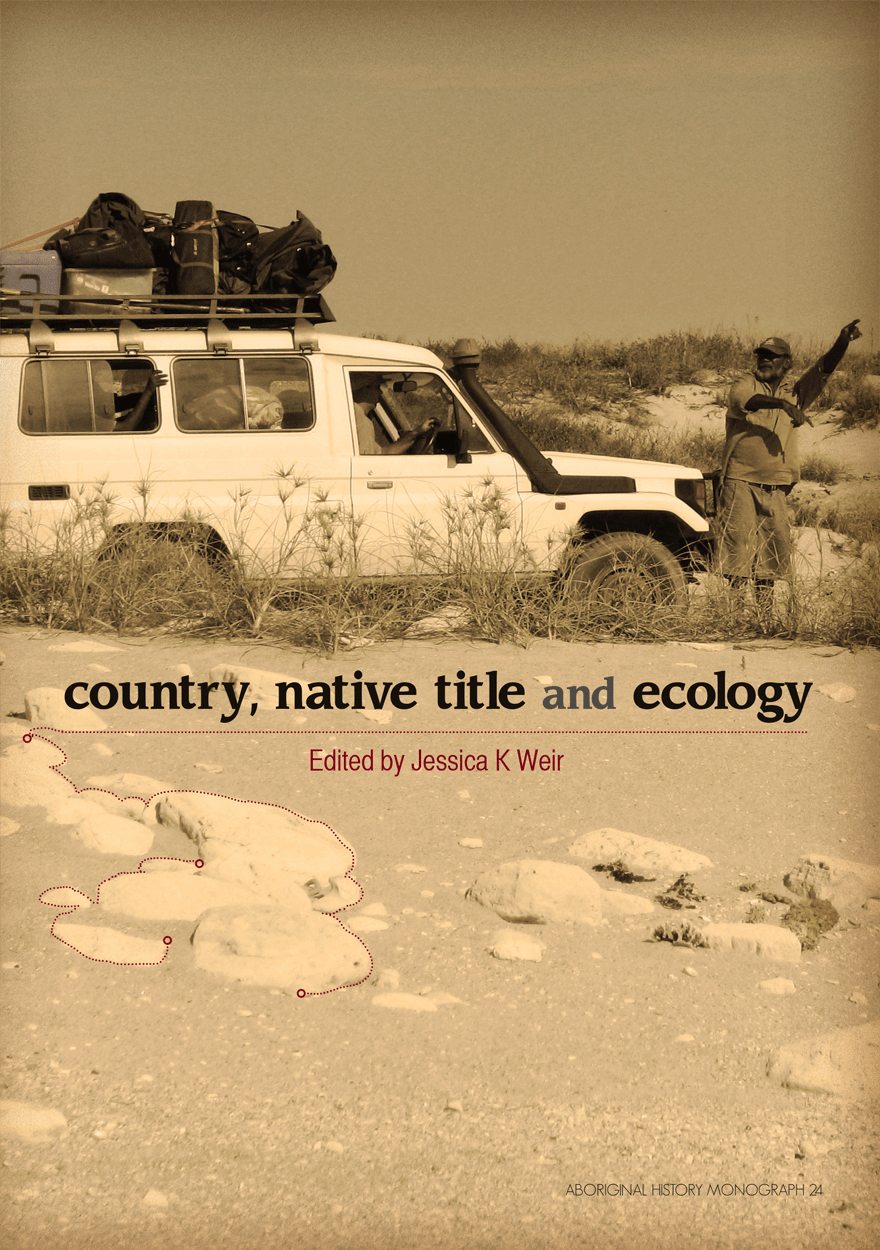
Country, Native Title and Ecology »
Edited by: Jessica K Weir
Publication date: March 2012
Country, native title and ecology all converge in this volume to describe the dynamic intercultural context of land and water management on Indigenous lands. Indigenous people’s relationships with country are discussed from various speaking positions, including identity and knowledge, the homelands debate, water planning, climate change and market environmentalism. The inter-disciplinary chapters range from an ethnographic description of living waters in the Great Sandy Desert, negotiating the eradication of yellow crazy ants in Arnhem Land, and legal analysis of native title rights in emerging carbon markets. A recurrent theme is the contentions over meaning, knowledge, and authority.
'Because this volume is scholarly, original and very timely it represents a key resource and reference work for land and sea managers; policy makers; scholars of the interface between post-native title responsibilities, NRM objectives and appropriate heritage protocols; and students based in the social sciences, natural sciences and humanities. It is rare for volumes to have this much cross-academy purchase and for this reason alone – it will have ongoing worth and value as a seminal collection.'
– Associate Professor Peter Veth, ANU College of Arts and Social Sciences, The Australian National University.

Julia 2010: The caretaker election »
Edited by: Marian Simms, John Wanna
Publication date: February 2012
This book provides a comprehensive coverage of one of Australia’s most historic elections, which produced a hung parliament and a carefully crafted minority government that remains a heartbeat away from collapse, as well as Australia’s first elected woman Prime Minister and the Australian Greens’ first lower house Member of Parliament.
The volume considers the key contextual and possibly determining factors, such as: the role of leadership and ideology in the campaign; the importance of state and regional factors (was there evidence of the two or three speed economy at work?); and the role of policy areas and issues, including the environment, immigration, religion, gender and industrial relations. Contributors utilise a wide range of sources and approaches to provide comprehensive insights into the campaign. This volume notably includes the perspectives of the major political groupings, the ALP, the Coalition and the Greens; and the data from the Australian Election Survey. Finally we conclude with a detailed analysis of those 17 days that it took to construct a minority party government.

East Asia Forum Quarterly: Volume 4, Number 1, 2012 »
Publication date: February 2012
East Asia Forum Quarterly grew out of East Asia Forum (EAF) online, which has developed a reputation for providing a platform for the best in Asian analysis, research and policy comment on the Asia Pacific region in world affairs. EAFQ aims to provide a further window onto research in the leading research institutes in Asia and to provide expert comment on current developments within the region. The East Asia Forum Quarterly, like East Asia Forum online, is an initiative of the East Asia Forum (EAF) and its host organisation, the East Asian Bureau of Economic Research (EABER) in the Crawford School of Economics and Government in the College of Asia & the Pacific at The Australian National University.
Download for free
Not available for purchase

Peopled Landscapes »
Archaeological and Biogeographic Approaches to Landscapes
Edited by: Simon G. Haberle, Bruno David
Publication date: January 2012
This impressive collection celebrates the work of Peter Kershaw, a key figure in the field of Australian palaeoenvironmental reconstruction. Over almost half a century his research helped reconceptualize ecology in Australia, creating a detailed understanding of environmental change in the Late Pleistocene and Holocene. Within a biogeographic framework one of his exceptional contributions was to explore the ways that Aboriginal people may have modified the landscape through the effects of anthropogenic burning. These ideas have had significant impacts on thinking within the fields of geomorphology, biogeography, archaeology, anthropology and history. Papers presented here continue to explore the dynamism of landscape change in Australia and the contribution of humans to those transformations. The volume is structured in two sections. The first examines evidence for human engagement with landscape, focusing on Australia and Papua New Guinea but also dealing with the human/environmental histories of Europe and Asia. The second section contains papers that examine palaeoecology and present some of the latest research into environmental change in Australia and New Zealand. Individually these papers, written by many of Australia’s prominent researchers in these fields, are significant contributions to our knowledge of Quaternary landscapes and human land use. But Peopled Landscapes also signifies the disciplinary entanglement that is archaeological and biogeographic research in this region, with archaeologists and environmental scientists contributing to both studies of human land use and palaeoecology. Peopled Landscapes reveals the interdisciplinary richness of Quaternary research in the Australasian region as well as the complexity and richness of the entangled environmental and human pasts of these lands.
— Prof. Peter Hiscock, The Australian National University

Reaching for Health »
The Australian women’s health movement and public policy
Authored by: Gwendolyn Gray Jamieson
Publication date: January 2012
The women’s health movement shocked and scandalised when it burst into Australian politics in the early 1970s. It cast the light of day onto taboo subjects such as sexual assault, abortion and domestic violence, provoking outrage and condemnation. Some of the services women created for themselves were subjected to police raids; sex education material was branded ‘indecent’. Moreover, women dared to criticise revered institutions, such as the medical system. Yet for all its perceived radicalism, the movement was part of a much broader and relatively conventional international health reform push, which included the ‘new’ public health movement, the community health centre movement and, in Australia, the Aboriginal health movement, all of which were critical of the way medical systems had been organised during the 20th century. The women who joined the movement came from diverse backgrounds and included immigrant and refugee women, Aboriginal women and Anglo women. Initially, groups worked separately for the most part but as time went on, they found ways to cooperate and collaborate. This book presents an account of the ideas, the diverse and shared efforts and the enduring hard work of women’s health activists, drawn together in one volume for the first time. This relentless activism gradually had an impact on public policy and slowly brought forth major attitudinal changes. The book also identifies the opportunities for health reform that were created along the way, opportunities which deserve to be more fully embraced.

Scholars at War »
Australasian Social Scientists, 1939–1945
Edited by: Geoffrey Gray, Doug Munro, Christine Winter
Publication date: January 2012
Scholars at War is the first scholarly publication to examine the effect World War II had on the careers of Australasian social scientists. It links a group of scholars through geography, transnational, national and personal scholarly networks, and shared intellectual traditions, explores their use, and contextualizes their experiences and contributions within wider examinations of the role of intellectuals in war.
Scholars at War is structured around historical portraits of individual Australasian social scientists. They are not a tight group; rather a cohort of scholars serendipitously involved in and affected by war who share a point of origin. Analyzing practitioners of the social sciences during war brings to the fore specific networks, beliefs and institutions that transcend politically defined spaces. Individual lives help us to make sense of the historical process, helping us illuminate particular events and the larger cultural, social and even political processes of a moment in time.
Contributors include Peter Hempenstall, JD Legge, Jock Phillips, John Pomeroy, Cassandra Pybus, David Wetherell, Janet Wilson.

Māori and Aboriginal Women in the Public Eye »
Representing Difference, 1950–2000
Authored by: Karen Fox
Publication date: December 2011
From 1950, increasing numbers of Aboriginal and Māori women became nationally or internationally renowned. Few reached the heights of international fame accorded Evonne Goolagong or Dame Kiri Te Kanawa, and few remained household names for any length of time. But their growing numbers and visibility reflected the dramatic social, cultural and political changes taking place in Australia and New Zealand in the second half of the twentieth century.
This book is the first in-depth study of media portrayals of well-known Indigenous women in Australia and New Zealand, including Goolagong, Te Kanawa, Oodgeroo Noonuccal and Dame Whina Cooper. The power of the media in shaping the lives of individuals and communities, for good or ill, is widely acknowledged. In these pages, Karen Fox examines an especially fascinating and revealing aspect of the media and its history — how prominent Māori and Aboriginal women were depicted for the readers of popular media in the past.